California trucker sentenced to 151 months for hauling cocaine and fentanyl in his sleeper — he admitted he was paid $30,000 for the run
Claude Bell, 58, of Lancaster, California, was sentenced on Nov. 19 to 151 months in federal prison, plus five years of supervised release, for possession with intent to distribute five kilograms or more of cocaine. An Arkansas trooper who stopped his tractor-trailer on Interstate 40 in Russellville in May 2025 — after Bell behaved nervously and had no logbook — found four boxes in the sleeper holding approximately 86 pounds of cocaine and approximately 34 pounds of fentanyl. Bell pleaded guilty in May 2026 and admitted he was paid $30,000 to carry the cocaine from Bueno Park to Memphis.
Summarized from The Trucker.
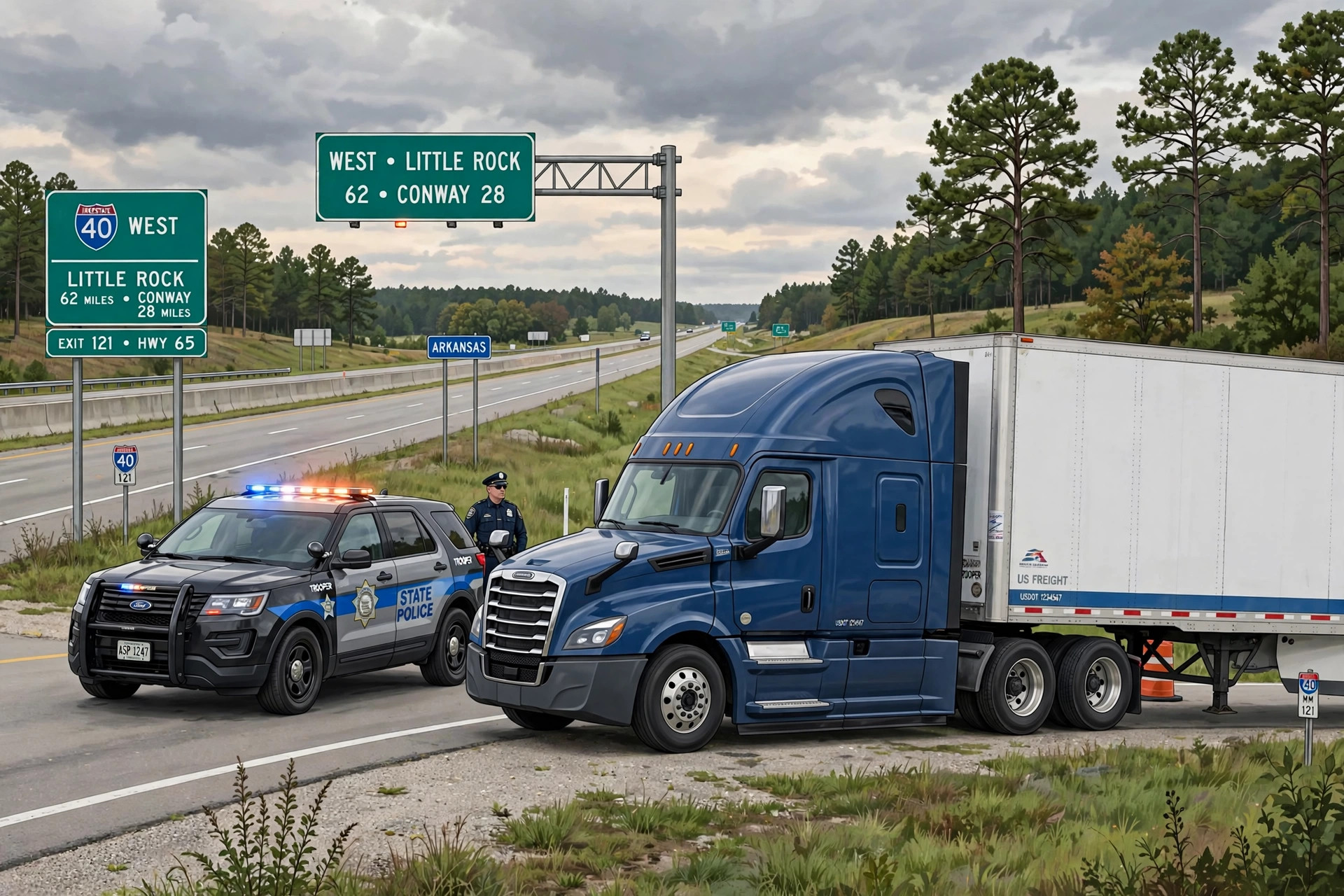
Image: Illustration: AI-generated by CDLWire
A California truck driver who carried four boxes of cocaine and fentanyl in his sleeper berth will spend 151 months in federal prison, according to The Trucker on Nov. 21, reporting the U.S. Attorney's Office for the Eastern District of Arkansas — a sentence that prices a single paid drug run at more than twelve years of a driver's life.
Claude Bell, 58, of Lancaster, California, was sentenced on Thursday, Nov. 19, by Chief United States District Judge Kristine G. Baker to 151 months in federal prison for possession with intent to distribute five kilograms or more of cocaine. Jonathan D. Ross, United States Attorney for the Eastern District of Arkansas, announced the sentence. Bell was also sentenced to five years of supervised release, and there is no parole in the federal system — the 151 months are served, not discounted by a parole board. A federal grand jury had indicted Bell in a two-count indictment for possession with intent to distribute cocaine and possession with intent to distribute fentanyl; on May 14, 2026, Bell pleaded guilty to possession with intent to distribute five kilograms or more of cocaine. The sentence is therefore the outcome of his own guilty plea, not a jury's verdict, and CDLWire reports the underlying facts as the U.S. Attorney's release states them.
The stop that began the case was an ordinary Interstate 40 traffic stop that turned on two details every driver should recognize. On May 19, 2025, a trooper with the Arkansas State Police conducted a traffic stop in Russellville on a tractor-trailer being driven by Bell. During the stop, the trooper observed Bell behaving nervously. Bell did not have a logbook to show his driving time — and at that point, the trooper obtained consent from Bell to search the tractor and trailer. During a search of the sleeper area of the truck's cab, the trooper located four boxes containing packages of approximately 86 pounds of cocaine and approximately 34 pounds of fentanyl. Bell was placed under arrest, and agents from the Drug Enforcement Administration arrived on scene and took custody of the packaged cocaine and fentanyl. The sequence is worth reading slowly: a roadside stop, nervous behavior, a missing logbook, a consent search, and a career — and a life — over in the sleeper of the truck.
What Bell told investigators afterward is the figure that will circulate in truck stops, and it should circulate with the sentence attached to it. During a post-Miranda interview, Bell admitted he was paid $30,000 to transport the cocaine from Bueno Park, California, to Memphis, Tennessee. Based on a search warrant, officers reviewed Bell's cell phone, which showed he picked up the boxes in California and was traveling to deliver them to an individual at a gas station in Memphis. Thirty thousand dollars for one run, against 151 months in federal prison and five years of supervised release after it: the arithmetic of the offer is the whole story, and it is the arithmetic recruiters for drug organizations count on a driver not doing at the moment the offer is made.
The record Bell carried into the courtroom is part of the release, and it is part of how a sentence like this is built. The U.S. Attorney's Office stated that Bell's prior felony convictions, which date back to 1987, include robbery, vehicle grand theft, second degree burglary of a vehicle, second-degree robbery, and second-degree attempted burglary. The case was investigated by the DEA, with assistance from the Arkansas State Police, the Fifth Judicial Drug Task Force and the Central Arkansas Drug Task Force, and was prosecuted by Assistant United States Attorney Shelby Shelton. A multi-agency investigation list like that one is the standard shape of an interstate drug case once a roadside seizure is made: the trooper's stop becomes a federal prosecution, and the load's origin, destination and phone records become the evidence.
CDLWire has covered this pattern before — drivers sentenced for hauling drugs in commercial trucks on interstate corridors — and the elements do not change: a consent search at a routine stop, a load hidden in the cab rather than the trailer, a cash payment that sounds large until it is divided by the years it costs, and a delivery arranged by phone to a meeting point at the destination. The professional lesson is not complicated, and it is not really about drugs. It is about the moment of the offer. Nobody recruits a driver by describing 151 months; they describe $30,000 and a drive to Memphis. The sentence handed down on Nov. 19 is the other half of that description, delivered by a federal judge in Little Rock, and it is the half worth repeating: the run from Bueno Park to Memphis that Claude Bell agreed to make in May 2025 will now run, in prison time, into the late 2030s.
Sources
Related coverage
 November 21, 2026 · EnforcementDriver in the I-35 Austin pileup that killed five is reindicted on 22 felony counts — two counts upgraded as injury information firmed up
 November 21, 2026 · EnforcementCHP's Sonora obstructed-window blitz wrote 53 tint citations and 45 other vehicle-code citations in one day — and the law it enforced is narrower than the headline
 November 20, 2026 · EnforcementThe lead defendant in the $100 million Brinks truck heist pleaded guilty — his crew followed truckers to their stops for five months
Comments
Loading comments…